




Fast Electric Bikes in 2026: What Real Speed Actually Looks Like
You've seen the listings. "45 mph top speed." "6000W monster motor." Bold numbers, confident claims — and then you read the fine print: under ideal conditions, lightweight rider, flat surface, full battery. For most people, that means the bike you paid for and the bike you actually ride are two different things.
If you've been burned by an overhyped e-bike before, or you're trying to avoid that mistake the first time around, this guide is for you. We'll cover what actually makes a fast electric bike fast, what speed range you should realistically expect, and which machines in 2026 deliver on the numbers they advertise.
Why Most "Fast" E-Bikes Disappoint
The problem isn't always the motor. It's the mismatch between the drivetrain and everything around it. A 5000W motor crammed into a bike with basic suspension, mechanical disc brakes, and a 48V battery is not a 45 mph bike — it's a fast motor in a slow bike's body. At real speed, the brakes can't stop you in time, the suspension can't absorb what the terrain throws at you, and the battery voltage drops off before you ever hit the advertised ceiling.
Real speed is a system. Motor, battery voltage, suspension, braking, tires, and frame geometry all have to be matched to the same performance target. When one component is underspec'd for the speed range being advertised, the whole thing falls apart the moment you leave a perfectly flat parking lot.
What Separates a Truly Fast Electric Bike from the Rest
Voltage First, Wattage Second
Most buyers focus on wattage. The riders who actually understand speed focus on voltage first. Higher voltage pushes more power through the motor at lower current — which means less heat, more consistent output under load, and a motor that holds its speed at 40+ mph instead of fading as the battery drains.
A 72V system at the same nominal wattage will outperform a 48V system every time at sustained high speed. If a listing doesn't show voltage clearly, or if it's 48V and claiming 45+ mph, treat that number skeptically. The voltage is the honest signal; the wattage headline is often marketing.
Motor Type Changes How Speed Feels
Hub-drive motors sit in the rear wheel and deliver power directly — great for sustained flat-out speed and simple to maintain. Mid-drive motors sit at the frame center and drive through the chain — better weight balance, stronger effective torque on hills, and more controlled handling at lower speeds on technical terrain. Neither is universally faster, but they feel completely different at speed.
For riders who want outright top speed on open terrain, hub-drive is typically the stronger choice. For riders who want speed that's controllable on steep, loose, or technical ground, mid-drive's centered weight distribution makes the bike more predictable when it matters most.
Weight Is the Silent Speed Killer
At 30 mph, weight matters a little. At 45–50 mph, aerodynamic drag becomes the dominant force working against the motor — and drag increases with the square of speed. A heavier bike needs more power just to maintain speed, which drains the battery faster and reduces real-world range at high speed by 30–40% compared to the manufacturer's listed figures.
This is why two bikes with identical motor specs can have meaningfully different real-world top speeds. Frame design, riding posture, and total system weight all affect the speed ceiling independent of the drivetrain.
How Fast Is Fast Enough for You?
Before shopping by peak speed, it helps to match your speed target to your actual riding conditions — because the hardware required changes significantly across speed tiers.
- Up to 28 mph: Class 3 street-legal range. Standard suspension and mechanical brakes are adequate. Wide model availability, most accessible price points.
- 28–40 mph: Starts to require hydraulic brakes and real suspension. 60V+ battery systems recommended. Off-road territory begins here.
- 40–50 mph: Demands 72V battery systems, inverted front forks or equivalent suspension, oversized hydraulic disc rotors, and off-road tires sized for the speed range. This is not commuter territory — these are purpose-built performance machines, and they need to be treated as such.
The Fastest Electric Bikes Worth Buying in 2026
Fastest for Off-Road: HappyRun G300 Pro
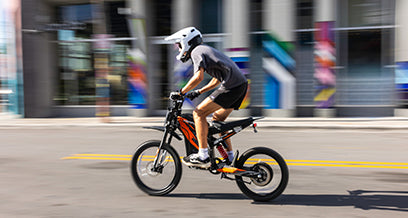
The G300 Pro is the bike HappyRun built specifically around the 50 mph target — and unlike most bikes that claim that number, the supporting hardware is actually spec'd for it. A 72V 30Ah battery paired with a 6500W peak hub-drive motor. Inverted front forks. Air-spring rear suspension. Hydraulic disc brakes with oversized rotors. 19"/17" deep-tread off-road tires.
Five power modes run from 13 mph (Class 1/2 street mode) up through the full 50 mph off-road ceiling. That range matters in practice — riders who start in Mode 1 and work up develop the throttle control and terrain judgment that 50 mph demands. The 72V 30Ah battery delivers up to 70 miles of range and fast-charges to 80% in 2.5 hours. Fits riders from 5'1" to 6'5", max load 350 lbs.
Honest caveat: 50 mph is a best-case figure — flat ground, full battery, lighter rider, Mode 5. Typical trail riding will put you in the 38–45 mph range under real conditions. That's still genuinely fast. Plan your expectations accordingly.
Fastest Mid-Drive Torque: HappyRun F18 2.0
The F18 2.0 gives up 4 mph at the top end (46 mph vs 50 mph) and gains significantly on technical terrain control. The 6000W mid-drive motor delivers 245 N·m of peak torque — the highest in HappyRun's lineup — with the motor positioned at the frame center rather than the rear wheel hub. That placement keeps weight balanced through corners and on steep climbs where a rear-heavy hub-drive machine becomes harder to manage.
Three gears (17 / 28 / 46 mph), hydraulic disc brakes, and a lower 26.5" seat height make the F18 2.0 the more accessible option for shorter adult riders and older teens who want full-performance off-road speed. The magnetic emergency kill switch cuts motor power immediately if the rider separates from the bike — a safety feature absent from most machines in this class.
What to Watch Out For When Buying
- 48V claiming 45+ mph: Physically possible on flat ground with a light rider. Practically misleading for anyone riding in the real world. Ask for the voltage before the wattage.
- No suspension specs listed: A bike that won't tell you fork travel and rear shock type isn't built for the speed it's advertising. At 40+ mph, suspension is a safety specification, not an upgrade.
- Mechanical disc brakes at high speed: Cable-actuated brakes require more lever force, provide less modulation, and fade under repeated hard use — exactly the conditions that come up off-road at speed. Hydraulic is the floor, not a premium.
- Range figures without speed context: A 70-mile range figure measured at 15 mph means roughly 40–45 miles at sustained 40+ mph. Always ask what speed the range is measured at before using it to plan rides.
Browse the full HappyRun electric dirt bike lineup to compare specs across all current models side by side.


Leave a comment