



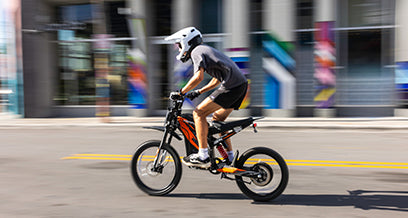

City Potholes to Weekend Trails: How Fat Tire E-Bikes Redefine All-Terrain Commuting
Fat Tire Electric Bike: From City Potholes to Weekend Trails
You want one bike that survives Monday's pothole-cracked commute and Saturday's gravel fire road, without owning two bikes. A fat tire electric bike does this by trading a little efficiency for a lot of stability — the wider contact patch absorbs impacts a standard 2-inch tire sends straight into your wrists.
This isn't a spec dump. It's a framework for matching tire width, motor power, and battery capacity to where you actually ride — plus a straight answer on whether "fastest" or "2000W" should even be on your checklist.
What Makes a Tire "Fat" — and Why 4 Inches Is the Number
A tire counts as fat once it crosses roughly 3.8–4 inches wide, run at low pressure (8–15 PSI vs. 35–60 PSI on a road tire). At that width, air volume — not tube pressure — absorbs the shock. That's the entire mechanical reason these bikes feel smoother over rough ground.
Most models, including HappyRun's Tank G60, settle on 20" x 4". That keeps pavement rolling resistance manageable while still giving sidewall flex for dirt and light sand. Narrower than 3.5" and you lose the cushioning; wider than 4.5" and rolling resistance climbs noticeably on asphalt.
The tradeoff is simple: fat tires give up a few mph of efficiency for a ride that doesn't beat up your body. Smooth bike lanes only? Skip this category. Potholes, train tracks, gravel shoulders? The wider footprint pays for itself in week one.
City Test: Potholes, Curbs, and Gravel Shoulders
A narrow tire concentrates impact force into a small contact area — that's why a pothole edge at speed can pinch-flat a tube or jolt you hard enough to lose your line. A 4-inch tire spreads that force across roughly double the contact area, and the added air volume compresses to absorb the hit instead of transferring it to the rim.
Three things matter most for city riding:
- Tire pressure. Above ~15 PSI, you lose the cushioning benefit entirely. Most riders find 10–12 PSI is the sweet spot for mixed pavement-and-pothole commuting.
- Curb hops and rail crossings. Added rubber volume lets you roll over a 2–3" curb lip at low speed without the front wheel deflecting — the failure mode behind most low-speed spills.
- Wet and gravel shoulders. Hydraulic disc brakes matter more here than tire width. Fat tire bikes carry more rotating mass and need stronger stopping power to compensate.
Battery placement matters too. A bike with the battery mounted low and centered — in the frame triangle, not on a rear rack — keeps the center of gravity stable during sudden braking and dodging.
Trail Test: Where Fat Tires Earn the Name
On loose dirt, sand, or light snow, the math flips — now it's flotation, not cushioning, doing the work. A wider tire spreads weight over more surface area, the same reason snowmobiles and beach vehicles use oversized, low-pressure tires.
For trail use, check these in order:
- Suspension travel. Front fork only (no rear shock) still transmits washboard vibration on longer rides. Full suspension is the difference between a 20-minute loop and a 2-hour one being comfortable.
- Torque, not just wattage. Climbing loose, rocky single-track depends on low-end torque, not peak watts. HappyRun's G60 Pro lists 95 N·m of torque — a more reliable predictor of hill-climbing than its 2000W peak figure alone.
- Tread pattern. Street-biased tires spin out on wet dirt or roots. If trail riding is regular, not occasional, prioritize deeper, wider-spaced knobs even if it costs you some pavement efficiency.
Honest limit: no commuter-leaning fat tire e-bike will out-climb a purpose-built electric dirt bike on technical single-track. If 80%+ of your riding is trail, you want dirt-specific geometry and suspension, not a city bike with trail capability bolted on.
The 2000W Question: Does More Power Mean a Better Ride?
No — and this is the most common buying mistake in the fat tire electric bike 2000w category. Peak wattage is a brief, ideal-conditions number. It tells you almost nothing about sustained climbing or real-world range.
The distinction that matters: rated (continuous) power vs. peak power. HappyRun's Tank G60 Pro runs a 1000W-rated motor with a 2000W peak, delivering 95 N·m of torque and a 36 mph top speed — it sustains 1000W for normal riding and only hits 2000W in short bursts like hard acceleration or steep pitches. A bike advertised as simply "2000W" with no rated figure may sustain only a fraction of that before thermal throttling kicks in. Always ask for the continuous rating, not just the peak.
Higher peak wattage does deliver two real benefits: faster acceleration from a stop, and more hill-climbing margin with cargo or a passenger. It also means a heavier motor, a bigger battery, and a higher price. Mostly flat-to-rolling city streets? A 750W-rated motor is enough — you're paying for headroom you won't use.
At the far end of HappyRun's lineup, the G100 Pro runs a 3000W-rated motor with a 6000W peak on a 72V 33Ah dual-battery system — roughly three times the rated power of the G60 Pro. That's not "more headroom." It's a different vehicle category, moped-style and off-road oriented.
"Fastest Fat Tire Ebike" Is the Wrong Question
Top speed is the easiest number to advertise and the hardest to use safely without context. Most U.S. e-bike classifications cap throttle-assisted speed at 20 mph (Class 2) or 28 mph (Class 3) on public infrastructure — check your state's law, since some treat higher-speed models as mopeds or off-road vehicles requiring registration.
If you're chasing the fastest fat tire ebike category, the G100 Pro is the relevant reference: 3000W-rated/6000W-peak on a 72V 33Ah dual battery, top speed up to 50 mph in its highest mode. The detail most listings bury: that 50 mph mode is explicitly off-road/private-property use, not a street-legal speed in most jurisdictions. The same bike configures down to roughly 28+ mph for street-legal use.
The better question is: fast at what battery cost? Top speed scales with power draw, and power draw scales inversely with range. A bike hitting 50 mph on a dual-battery pack burns through range faster at full throttle than the same bike in pedal-assist mode 2 or 3.
Comparison: Commuter vs. Performance vs. Budget
📱 Swipe left on mobile to view full table.
| Build Type | Motor (Rated/Peak) | Battery / Range | Best For | Watch Out For |
|---|---|---|---|---|
| City Commuter | 750W / 1500W peak | 48V 18Ah, ~68 mi | Daily pavement + potholes, light gravel | Underpowered for steep hills with cargo |
| Performance / Moped-Style | 1000W rated / 2000W peak, 95 N·m torque | 48V 25Ah, 80+ mi | Hills, mixed terrain, longer commutes | Heavier bike; verify Class 2/3 legality at full throttle |
| High-Speed / Off-Road | 3000W rated / 6000W peak | 72V 33Ah dual, ~78 mi | Experienced riders, private off-road use, touring | 50 mph mode is off-road only; heaviest bike in the lineup |
| Budget (Under $1,000) | 500–750W class | 36–48V, 30–50 mi | Light trail use, flatter terrain | Confirm UL 2849 certification and disc (not rim) brakes |
This isn't a ranking — it's a sorting exercise. Match the row to your terrain and commute distance before looking at specific models.
Under $1,000: What You're Actually Trading Away
A sub-$1,000 fat tire electric bike is a real, usable category — not automatically corner-cut. But three things commonly get trimmed, and you should check for them directly:
- Certification. UL 2849 is the relevant safety standard, covering motor, battery, controller, and charger as a complete system. Confirm the listing states UL 2849 with a certificate number — "UL-compliant components" is a different, weaker claim.
- Brake type. Mechanical disc brakes need more hand force and more frequent adjustment. If you'll see real hills or wet conditions, hydraulic brakes are worth prioritizing even at the budget tier.
- Battery cell source. Reputable brands at this price still use name-brand cells. Savings usually come from motor size and finish, not the cells themselves. If a listing won't disclose cell brand, ask before buying.
Choose Your Build
City Commuter if: 90%+ paved roads, commute under 15 miles round trip, hills rarely exceed 10% grade.
Performance/Hybrid if: your route mixes pavement with gravel, your commute exceeds 15 miles, or you regularly climb grades steeper than 10–12%.
High-Speed/Off-Road if: you have legal access to private or off-road land, prior experience at higher speeds, and you'll mainly run the street-legal 28+ mph mode with 50 mph reserved for controlled settings.
Dedicated trail build (not a commuter-leaning fat tire bike) if: 70%+ of your riding is unpaved single-track, or you need rear suspension travel beyond a fork-only setup. See HappyRun's electric dirt bike lineup for trail-first geometry.
Still unsure where your riding falls? Our breakdown of what real speed looks like on a 2026 electric bike covers how motor class and local speed laws interact.


Leave a comment