



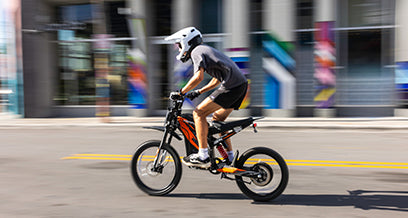

Electric Dirt Bike for Adults at 50 MPH — Where Real Speed Starts
The Voxan Wattman holds the electric motorcycle land speed record at 408 km/h. The Kawasaki Ninja H2R, the fastest production gas bike you can buy, tops out around 249 mph. These are the outer edges of what two-wheeled machines have ever done at speed — and they have almost nothing to do with what an adult buyer shopping for an electric dirt bike for adults at 50 mph actually needs.
But they matter as a reference point. Because once you understand where 50 mph sits in the full spectrum of two-wheeled performance — not at the extreme, but at the edge of what's legally rideable and mechanically manageable without a racing license or a closed track — the question changes. It's no longer "is 50 mph fast?" It becomes: "is 50 mph the right ceiling for me, and what does it actually take to get there on dirt?"
This guide answers both.
What 50 MPH Actually Means on Two Wheels
At 50 mph, you're covering 73 feet every second. On a paved highway in a car with crumple zones and airbags, that's a comfortable cruising speed. On an electric dirt bike with no windshield, no doors, and a surface beneath you that might be loose gravel or rutted hardpack — it's a completely different experience.
Riders who've hit 50 mph on a gas dirt bike already know the feeling: the way the bike gets light over small bumps, the compression of time between seeing an obstacle and reacting to it, the way your hands have to stay soft on the bars instead of gripping hard. Electric gets you there with one major difference — the torque arrives immediately, not after you've built revs. There's no gradual power climb. The first few rides at full throttle on a high-power electric machine are always an adjustment, regardless of how much gas riding experience you have.
That's not a warning to avoid 50 mph. It's context for why the hardware around the motor matters as much as the motor itself.
The Legal Speed Ceiling That Changes Everything
In the United States, e-bike classifications cap street-legal speeds at 28 mph (Class 3). An electric dirt bike capable of 50 mph sits well above that threshold and is classified for off-road and private-property use in most states — not for public roads or bike paths at that speed.
This isn't a flaw. It's the design intent. Off-road terrain — private land, closed tracks, farm roads, designated riding areas — is exactly where 50 mph on a dirt bike makes sense. You control the surface, the traffic (none), and the conditions. The speed ceiling that would make a bike dangerous in a shared-road environment becomes manageable in a controlled off-road context.
The G300 Pro handles this through its five-mode system: Modes 1 and 2 cap speed at 13 mph (Class 1/2 street-legal range), Mode 3/4 at 25 mph (Class 3 range), and Mode 5 unlocks the full 50 mph off-road ceiling. One bike, multiple legal contexts, depending on where you're riding and which mode you select.
What It Takes to Hit 50 MPH on Dirt — The Full System
Speed at this level isn't a single spec. It's a chain of hardware decisions that either support each other or undermine each other. A 50 mph motor in a bike with insufficient suspension and undersized brakes isn't a 50 mph machine — it's a liability wearing a spec sheet.
Voltage: Why 72V Is the Floor, Not the Ceiling
Voltage determines how much power the electrical system can push through the motor consistently under load. At 48V, a high-wattage motor can reach impressive peak speeds but starts to fall off during sustained high-speed riding — especially on inclines, in heat, or when the battery is below 50% charge.
A 72V system maintains more consistent output across a wider range of conditions. For a bike claiming a 50 mph ceiling, 72V isn't a premium upgrade — it's the minimum voltage architecture that makes that ceiling reliably achievable rather than just theoretically possible on a flat road with a full battery and a 140 lb rider.
Motor Output: Peak vs. What Sustains
Peak wattage is the number manufacturers lead with because it's the biggest. Continuous (rated) wattage is the number that predicts real-world climbing and sustained speed performance. A 3000W rated motor with a 6500W peak — like the G300 Pro — delivers strong burst acceleration for off-the-line performance and maintains enough continuous output for extended high-speed stretches without thermal throttling.
The 120 N·m of torque on the G300 Pro matters most at lower speeds — it's what lets the bike pull cleanly out of loose corners and maintain momentum on uphill dirt sections where the rear wheel is fighting for traction. Top speed and low-speed torque are both products of the same motor, but they serve very different moments in a real ride.
Suspension: The Spec That Matches the Speed
At 30 mph, a decent front fork is adequate. At 50 mph over rough ground, an undersized fork becomes the most dangerous component on the bike. The G300 Pro uses an adjustable inverted aluminum alloy front fork with 80–120mm of travel — a specification designed for the speed range this bike operates in, not retrofitted from a lower-performance platform.
The rear uses a vertical shock absorber tuned for off-road impact absorption. Taken together, the suspension system allows the bike to remain controllable over the kind of surface variations that appear at real trail speeds — not just smooth packed dirt, but rocks, roots, and sudden drops that come without warning at 50 mph.
Braking: Bigger Rotors, Not Optional
Stopping distance increases with the square of speed. A bike that stops cleanly in 20 feet at 25 mph needs roughly four times that distance at 50 mph under the same braking force. This is why rotor size matters at this performance tier: the G300 Pro runs a 180mm front rotor and a 203mm rear rotor, both hydraulically actuated.
Hydraulic brakes require less hand force, modulate more precisely under hard braking, and maintain performance under the heat generated by repeated stops — exactly the conditions that occur during sustained off-road riding at high speed. Mechanical disc brakes, common on lower-priced machines, fade under this kind of load. At 50 mph on dirt, that difference is not recoverable.
Who 50 MPH Is Actually Built For
Being direct about this is more useful than being vague, so here it is plainly:
- Experienced off-road riders who have already built throttle control, cornering judgment, and terrain-reading instincts on gas or lower-speed electric machines. The G300 Pro's five-mode system exists specifically so new riders don't have to start at Mode 5 — but the full 50 mph capability is designed for riders who've earned it through lower-mode experience first.
- Adult riders with access to appropriate terrain. Private land, farms, closed off-road parks, and designated riding areas are the natural home for a 50 mph dirt bike. If the only place you ride is public roads and trails, this speed ceiling isn't relevant to your actual use case.
- Riders moving up from gas. The transition from gas dirt bikes to electric at this performance level is straightforward for experienced riders — the main adjustment is to the immediacy of electric torque rather than a built-up power band. The absence of a clutch simplifies the technical side significantly.
First-time off-road riders should start in Mode 1 or 2 and treat Mode 5 as something to work toward. The bike doesn't require full performance to be useful — most riders report spending significant time in mid-range modes even after developing confidence at the higher end.
The HappyRun G300 Pro: How It Gets There
The HappyRun G300 Pro is designed specifically around the 50 mph off-road target for adult riders. The hardware chain described above — 72V system, 6500W peak motor, inverted front fork with adjustable travel, oversized hydraulic rotors, deep-tread off-road tires in 19"/17" sizing — reflects a consistent engineering decision to match every component to the same performance level rather than building a fast motor into a mid-grade chassis.
Motor: 6500W peak / 3000W rated | 120 N·m torque
Battery: 72V 30Ah removable | 2,160 Wh total capacity
Top Speed: 50 mph (Off-Road Mode) | 28 mph (City Mode)
Range: 70+ miles
Suspension: Inverted front fork 80–120mm travel | Vertical rear shock
Brakes: Hydraulic disc | 180mm front / 203mm rear rotors
Tires: 70/100-19 front | 70/100-17 rear
Seat Height: 31" | Rider Height: 5'1"–6'5" | Max Load: 350 lbs
Fast Charge: 80% in 2.5 hours | Full charge in 5–6 hours
Current Price: from $1,899 (was $3,499)
One honest caveat, because it matters for planning: the 50 mph figure is a best-case ceiling — flat terrain, full battery, lightest supported rider weight, Mode 5. Real trail riding puts most riders in the 35–45 mph range depending on terrain, elevation, and throttle management. That's still genuinely fast and well above what most off-road riding scenarios actually require. Plan for the real-world range, not the spec sheet maximum.
The 2000-lumen front headlight and integrated rear turn signals extend the bike's usability beyond daylight hours — a practical detail that matters for riders doing longer sessions. The IPX5 waterproof rating means light rain and wet trail conditions aren't cause to turn back. The removable 72V 30Ah battery ships separately for safety compliance and can be charged independently — useful for riders who want to bring a second battery for extended sessions.
For a full comparison of how the G300 Pro sits alongside other models in the lineup, the electric dirt bike collection page covers all current models side by side with complete specs, and Electric Dirt Bike for Adults at 50 MPH .


