



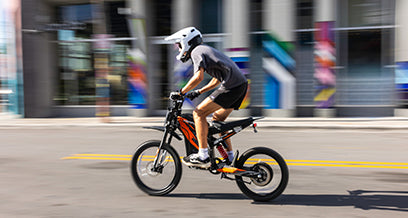

Electric Dirt Bike for Adults at 50 MPH — Performance, Hardware & Who It's For
Most adults shopping for a fast electric dirt bike already have a number in their head: 50 mph. It shows up in product listings, in YouTube titles, in conversations between riders who've outgrown their first electric machine. The problem is that 50 mph on a dirt bike is a completely different experience from 50 mph in a car — and an even more different experience from 28 mph on a Class 3 commuter e-bike. Before you build a purchase around that number, it helps to understand what it actually takes to hit it, what it feels like when you do, and whether your terrain and experience level are actually suited for it.
This guide is written for adult riders who are seriously considering a 50 mph electric dirt bike — not as marketing material, but as a realistic breakdown of what the hardware requires, what the riding experience demands, and where the limits are. Because the gap between a 35 mph electric dirt bike and a genuine electric dirt bike for adults 50 mph-capable machine isn't just a motor spec. It's a whole system.
What 50 MPH Actually Feels Like on Dirt
Riders who've only hit 50 mph in a car tend to underestimate it on a two-wheeled machine with no doors, no seatbelt, and a surface that might be loose gravel, dried mud, or rutted hardpack under the wheels. At that speed on dirt, the bike is covering about 73 feet per second. A mid-sized rock, a deep rut, or a patch of sand you didn't see coming gives you less than half a second to react before contact.
That's not a reason to avoid 50 mph riding — it's a reason to respect what the machine needs to do it safely. Experienced off-road riders who've ridden gas dirt bikes at speed will recognize the demands immediately. First-time off-road buyers who've only ridden street e-bikes should treat 50 mph capability as a ceiling to grow into over multiple sessions, not a setting to run on day one.
What experienced riders consistently report is that the electric version of this experience has one major difference from gas: the torque arrives earlier and more linearly. There's no building rev range, no power band to find. When you open the throttle on a high-power electric dirt bike, the acceleration is immediate. At 50 mph this is both a performance advantage and a reason to take the first few rides seriously — the learning curve is about managing instant torque, not a clutch or gear changes.
The Hardware That Makes 50 MPH Possible
A genuine fast electric dirt bike for adults at this speed ceiling isn't built from a single impressive spec — it's a system where motor, battery, suspension, and brakes all have to be sized for the same operating range. A bike with a big peak wattage number but undersized suspension or mechanical disc brakes isn't a 50 mph bike. It's a bike with a misleading spec sheet.
Motor Power: Peak vs. What Matters on Trail
Peak wattage is what most listings lead with. A 6500W peak motor sounds impressive — and it is — but peak output is a burst figure that the motor reaches under maximum load for a short period. The more useful number for sustained trail riding is the continuous (rated) wattage, which is what the motor puts out over a long climb or extended throttle stretch without thermal throttling.
For a sustained 50 mph capability on dirt — not just a brief flat-ground burst — you need a motor system with enough continuous output to maintain that speed under load. High-voltage systems (72V) help here because they push more power through the motor at lower current, which reduces heat buildup during sustained high-output riding. At equivalent wattage ratings, a 72V system will generally outperform a 48V system in sustained high-speed conditions.
Battery Voltage: Why 72V Changes the Equation
Voltage is the spec that separates a fast-feeling electric dirt bike from one that actually sustains performance at speed. Lower-voltage batteries (48V, 52V) can put up impressive peak numbers but start to fall off under the sustained load of high-speed trail riding — particularly on climbs, in hotter weather, or at lower battery charge levels.
A 72V system maintains more consistent power delivery across a wider range of conditions. For a rider who wants to hit 50 mph on a trail and then immediately climb a steep grade without feeling the bike drop power, voltage matters as much as the peak wattage. Capacity (measured in amp-hours, Ah) determines range. A 72V 30Ah battery delivers more range at high speed than a 72V 20Ah battery, though both run the same voltage system.
Suspension: The Spec Most Buyers Skip
Suspension is where most buyers make the most consequential mistake when shopping for a high-speed dirt bike. At 50 mph on a trail, you're asking a suspension system to absorb impacts that arrive faster than your hands and body can consciously react to. A front fork that's adequate at 30 mph starts to feel vague and dangerous at 50 mph over rough ground.
The specs to look for: inverted (upside-down) front forks for better rigidity under load, adjustable rear shock with meaningful travel distance, and a suspension setup that can be tuned for rider weight. Air-assisted rear suspension allows more precise tuning than spring-only setups. If a bike is marketed as a 50 mph machine but only shows basic suspension specs in its listing, treat that claim with significant skepticism — the suspension is often where corners are cut on lower-priced high-speed builds.
Braking: The One Area You Cannot Compromise
Hydraulic disc brakes are non-negotiable on a genuine electric dirt bike for adults 50 mph-capable machine. Cable-actuated mechanical disc brakes, which appear on many lower-priced electric bikes including some marketed as high-speed, require more lever force, provide less modulation, and fade under repeated hard use — exactly the conditions that come up in off-road riding at speed.
Rotor size matters alongside brake type. A 180mm rotor will stop a bike at 30 mph. The same bike at 50 mph needs significantly more thermal capacity and bite. Look for rotors of 200mm or larger on the front wheel, and confirm hydraulic actuation before assuming any brake spec is adequate for this speed range.
Who Should — and Shouldn't — Buy a 50 MPH Electric Dirt Bike
Being honest about this matters more than most product guides acknowledge, so here it is directly.
Good candidates for a 50 mph electric dirt bike:
- Adults with prior dirt bike experience — gas or electric — who have developed throttle control, cornering judgment, and the instincts to read terrain at speed
- Riders who will start in lower power modes and work up gradually, using the bike's mode system as a tool rather than treating Mode 5 as the default
- Riders with access to appropriate terrain — private land, closed off-road parks, or trails where high-speed riding is legal and conditions are known
- Adults who understand that 50 mph is a ceiling under optimal conditions, not a guaranteed everyday operating speed
Riders who should consider a lower-speed machine first:
- First-time off-road riders with no prior dirt or trail riding experience — starting at 50 mph capability is a steeper learning curve than it needs to be
- Riders whose primary terrain is urban streets or mixed pavement — a 50 mph dirt bike is not the right tool for commuting, and using it that way typically reduces both range and component lifespan
- Anyone who won't consistently wear appropriate protective gear — at 50 mph off-road, a DOT helmet, gloves, boots, and body armor aren't optional
The HappyRun G300 Pro: How It Hits 50 MPH
The HappyRun G300 Pro is built specifically around the 50 mph capability for adult off-road riders. It's worth walking through how the hardware connects to that number, because it illustrates exactly the system approach described above — rather than a single impressive spec with compromises elsewhere.
The drivetrain is a 72V 30Ah removable battery paired with a 6500W peak motor. The 72V system maintains consistent power delivery under sustained load — the kind of load that comes from extended high-speed riding on rough terrain, not just a brief flat-ground acceleration test. Five selectable power modes give riders a legitimate range from controlled low-speed practice up to full performance output.
Suspension is where the G300 Pro's dirt-specific engineering shows most clearly. The front uses a triple-clamp inverted fork setup with meaningful travel; the rear runs an air-assisted shock that can be tuned for rider weight and terrain conditions. The 19"/17" tire configuration uses deep-tread off-road rubber sized for the speed range — not repurposed fat commuter tires. At 50 mph on a dirt trail, those tires are doing the majority of the stability work, and their sizing and compound matter.
Braking is hydraulic across both wheels, with rotor sizing appropriate for this speed class. The 350 lb load capacity and 787mm seat height cover the range of adult riders this bike is designed for; the adjustable ergonomics allow riders of different heights to find a proper fit rather than working around a frame that doesn't suit them.
One honest note: the 50 mph figure is an upper-bound measurement under optimal conditions — flat ground, full battery charge, lighter rider, highest power mode. Real-world top speed on trail riding is typically lower due to terrain variation, elevation, and throttle management. This is true of every electric dirt bike at this performance level, not a G300 Pro-specific limitation. Plan around a working range of 38–45 mph for typical trail riding conditions, with 50 mph as the occasional flat-out capability.
Frequently Asked Questions
Is a 50 mph electric dirt bike street legal?
In most U.S. states, no. A high-power, high-speed electric dirt bike like the G300 Pro is designed for off-road use — private land, closed tracks, and designated off-road riding areas. Street legality depends on state and local regulations including motor power limits, lighting requirements, and registration rules. Some riders do register and plate similar bikes in states with more permissive rules, but this requires verifying your specific jurisdiction's requirements. HappyRun does not make claims about street legality for specific locations.
How does a 50 mph electric dirt bike compare to a gas dirt bike at the same speed?
The primary differences riders notice when switching from gas: electric delivers full torque from zero RPM with no clutch or gear management; there is no auditory rev feedback to gauge speed and power output; and maintenance requirements drop significantly (no engine oil, spark plugs, air filters, or carburetor tuning). The riding speed, physical demands, and terrain judgment required are comparable to gas riding at the same speed — the skill gap is in adapting to instant torque rather than a managed power band.
What safety gear do you need for 50 mph off-road riding?
At minimum: a DOT or ECE-rated full-face helmet, riding gloves, over-the-ankle boots, and a jacket with CE-rated elbow and shoulder armor. For sustained 50 mph off-road riding on technical terrain, add knee guards, a chest protector, and back protection. The consequence of a fall at this speed on dirt without proper protection is severe. The gear investment is small relative to the cost of the bike and significantly smaller relative to the cost of an injury.
Can beginners ride an electric dirt bike at 50 mph?
Not safely on day one. The multi-mode power system on the G300 Pro exists specifically so that newer riders can start in Mode 1 or 2, which limits top speed and softens throttle response to a manageable level. Mode 5 — where 50 mph is accessible — should be earned over multiple riding sessions as throttle control, braking judgment, and terrain reading improve. The bike doesn't require you to use its full performance ceiling; most riders spend significant time below it even after they've mastered lower modes.
Ready to see the full HappyRun off-road lineup? The electric dirt bike collection covers all current models with full specs and current pricing. For a broader look at everything HappyRun builds across categories, the main site is the starting point.


