




Best Electric Dirt Bike Under $2,000 in 2026
Two thousand dollars is a real budget — enough to get a genuinely capable electric dirt bike, but also enough to buy something disappointing if you don't know which specs actually matter. At this price point, the gap between bikes isn't always visible on a spec sheet. A 6000W peak motor sounds the same whether it's a hub-drive or a mid-drive, whether the suspension is properly rated for trail speeds, or whether the brakes will hold up after repeated hard stops on a downhill.
This guide is built around one question: if you have $2,000 and you want the best electric dirt bike you can get for it, what should you actually be looking at? We'll walk through the specs that determine real-world performance at this price tier, what most budget bikes quietly skip, and which model in 2026 gives you the most for your money.
What $2,000 Actually Buys You in This Category
The $2,000 ceiling used to mean significant compromises on electric dirt bikes — underpowered motors, spring-only suspension, mechanical disc brakes, and no meaningful safety features. That's changed. In 2026, $2,000 gets you into genuine off-road performance territory: mid-drive motors, full suspension, hydraulic brakes, and top speeds in the 40+ mph range.
The catch is that not every bike in this price range delivers all of that. Some lead with wattage and bury weaker specs everywhere else. Some look capable in photos and feel soft on real terrain. Knowing which five specs to check before anything else is how you avoid a $1,500 mistake.
The Five Specs That Separate the Good From the Forgettable
Motor Placement: Hub-Drive vs. Mid-Drive
Most electric dirt bikes — even at $2,000 — use hub-drive motors. The motor sits in the rear wheel hub and pushes the bike forward directly. It's mechanically simpler and cheaper to produce, which is why it dominates the budget segment.
Mid-drive motors sit at the center of the frame and drive the rear wheel through the chain. That placement keeps weight centered and low, which changes how the bike handles on technical terrain — tighter cornering, better balance on steep climbs, more predictable throttle response at low speed when traction is marginal. At equivalent wattage ratings, mid-drive systems generally deliver stronger effective torque on hills because the motor works with the bike's leverage geometry rather than against it.
At the $2,000 price point, mid-drive is rare. When you find it, it's the most meaningful differentiator in the category.
Torque Rating: The Number Most Listings Bury
Peak wattage is what sellers lead with. Torque — measured in N·m — is what predicts how the bike actually performs on a loose climb, out of a slow corner, or when carrying a heavier rider. High peak wattage with low torque means impressive flat-ground acceleration and disappointing hillclimbing. High torque at this price range is genuinely hard to find.
For context: most hub-drive bikes in the $1,000–$2,000 range list torque figures in the 80–120 N·m range. A mid-drive machine at 245 N·m in this price category is not a common find — and torque at that level changes what you can do on technical dirt in ways that a wattage upgrade alone doesn't.
Suspension: Full or Fork-Only
Fork-only (hardtail) suspension means the rear of the bike transmits every trail impact directly through the frame to the rider. On smooth, packed dirt, that's manageable. On anything rougher — washboard, roots, loose rock — it wears you out faster and limits how confidently you can push the speed. At 40+ mph on rough ground, rear suspension isn't a comfort feature, it's a control feature.
Full suspension — front hydraulic fork plus rear shock — is standard on bikes built for real trail use. Check whether the rear shock is oil-spring or air-adjustable: oil-spring damping is adequate for most riders; air suspension allows tuning for rider weight and terrain, which matters if you ride multiple surfaces regularly.
Brakes: Hydraulic Is the Floor, Not the Upgrade
Mechanical disc brakes are common below $1,000. At $2,000, you should expect hydraulic on both wheels. Hydraulic brakes require less hand force, modulate more precisely under hard braking, and maintain consistent feel under the heat generated by repeated downhill stops — exactly the conditions that expose the weakness of cable-actuated mechanical brakes.
Rotor size matters alongside brake type. Larger rotors (180mm+) dissipate heat faster and provide more stopping force at speed. If a bike in this price range doesn't list rotor diameter, or if the rotors are under 160mm, that's a signal worth noting.
Safety Features: What Budget Bikes Skip
Most electric dirt bikes under $2,000 offer nothing beyond the motor and power modes. A small number include features that make meaningful real-world differences:
- Magnetic emergency kill switch: Cuts motor power instantly if the rider separates from the bike. On a machine capable of 40+ mph, this prevents the bike from continuing forward after a fall.
- Reverse function: Lets you back the bike out of tight spots without dismounting and pushing. More useful than it sounds on technical terrain with limited turning radius.
- NFC card startup: Prevents unauthorized use. Not essential, but worth having on a machine at this price point.
These features add cost. Finding all three together under $2,000 is uncommon enough that it's worth calling out when it happens.
What to Watch Out For at This Price
- "6000W" without a mid-drive designation: A 6000W hub-drive and a 6000W mid-drive feel completely different on trail. Hub-drive is common and capable; mid-drive at this price is rare and meaningfully better on technical terrain. Check which one you're actually getting.
- Torque figures not listed: If a brand won't tell you the torque rating, they're usually not proud of it. Ask specifically, or look for it in the spec sheet — not the marketing headline.
- Range figures without speed context: A 60-mile range figure measured at 15 mph means 35–40 miles at full throttle. Always check what speed the range is measured at, or plan conservatively.
- Seat height mismatches: A 33-inch seat height on a 46 mph dirt bike means some riders will struggle to maneuver confidently at a stop on uneven ground. Check your inseam against the listed seat height before ordering — a bike that doesn't fit properly is harder to control regardless of its specs.
The HappyRun F18 2.0 — The Sub-$2,000 Benchmark
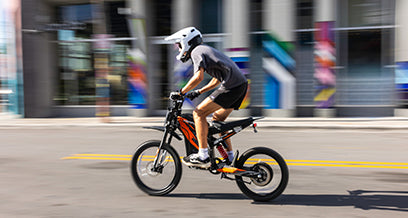
The HappyRun F18 2.0 is currently priced at $1,198.99 — well under the $2,000 ceiling — and it's the bike in this price tier that checks the hardest boxes to find: mid-drive motor, 245 N·m peak torque, full suspension, hydraulic disc brakes, and all three safety features (magnetic kill switch, reverse, NFC startup) in a single package.
The mid-drive 6000W motor is the starting point. 245 N·m of peak torque through a centered motor placement gives the F18 2.0 a fundamentally different climbing and cornering character than hub-drive alternatives at this price — you feel it most in the moments where traction is marginal: loose gravel climbs, wet roots, tight switchbacks where you're managing speed and throttle simultaneously at low speed.
Three gears — Gear 1 at 17 mph, Gear 2 at 28 mph, Gear 3 at 46 mph — give structured progression rather than a single wide-open throttle response. New riders stay in Gear 1 or 2 until they've built confidence; experienced riders use all three to match terrain. Top speed of 46 mph is the full off-road figure; always verify your local regulations before riding at that speed on public land.
Motor: 6000W peak / mid-drive / 245 N·m peak torque
Battery: 60V 30Ah (1800Wh) / removable
Top Speed: 46 mph / Gear 1: 17 mph / Gear 2: 28 mph
Range: Up to 60 miles
Suspension: Front hydraulic shock + rear oil-spring damping
Brakes: Hydraulic disc / 190mm rotors
Tires: 17" front / 14" rear / aggressive off-road tread
Seat Height: 26.5" / Rider Height: 3'11"–6'1" / Max Load: 300 lbs
Charge: 40–80% in 2.5 hrs / full charge in 7 hrs
Safety: Magnetic kill switch / reverse / NFC card startup
Price: $1,399 (check product page for current promotions)
The 26.5-inch seat height is the F18 2.0's most underrated spec. It's the lowest seat height in HappyRun's current lineup — and significantly lower than most competing bikes at this power level. Shorter adult riders and older teens who've struggled to flatfoot taller machines will find the F18 2.0 considerably more manageable at a stop on uneven ground. Combined with the mid-drive's centered weight distribution, the bike feels more planted at low speed than its 6000W rating might suggest.
Honest limits: the 300 lb max load is the tightest in HappyRun's lineup — heavier riders approaching that ceiling will want to check the G300 Pro's 350 lb rating instead. The 60-mile range is the shortest of the three current dirt bike models; plan conservatively at sustained Gear 3 riding. And the 7-hour full charge time is longer than you'd want for back-to-back riding sessions — the 2.5-hour charge to 40–80% is the practical solution for most riders.
Who Should Buy the F18 2.0 (And Who Shouldn't)
Buy the F18 2.0 if:
- Your terrain includes real hills, loose climbs, or technical single-track where mid-drive torque and centered balance matter more than outright top speed
- You're a shorter adult rider or an older teen — the 26.5" seat height is a genuine fit advantage that taller machines can't match
- You want the full safety feature set (kill switch, reverse, NFC) without paying a premium for it
- You're working within a strict budget and want the most performance for under $2,000
Consider other options if:
- Your priority is outright top speed — the G300 Pro at 50 mph is the answer for that, at a slightly higher price point
- You're a heavier rider near or above 300 lbs — the G300 Pro and G18 Pro's 350 lb ratings give more margin
- You need maximum range for long all-day rides — the G18 Pro's 75-mile rating is the better choice there
For a full side-by-side comparison of all three models, the G300 Pro vs F18 2.0 vs G18 Pro comparison guide covers each model's strengths and the scenarios where each one wins. The full electric dirt bike collection has current pricing and specs for all three.


