



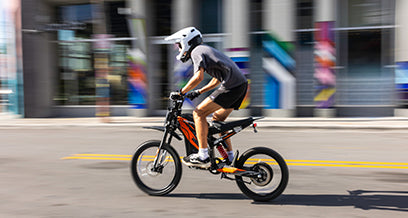


How Fast Can You Really Go on an Off-Road E-Bike?
Off-road electric bikes typically reach speeds of 20-28 mph, but modified versions can exceed 80 mph. Speed depends on motor power and local regulations. Some models offer class switching for varied speeds on trails or in town.
What Factors Determine the Speed of an Off-Road Electric Bike?
The speed of an off-road electric bike hinges on motor power, battery capacity, local regulations, and the bike's class. Higher wattage motors and batteries allow for increased speeds, but legal limits often cap these.
How Do Different E-Bike Classes Affect Speed Capabilities?
E-bike classes impact speed: Class 1 and Class 2 bikes are limited to 20 mph, while Class 3 bikes can reach up to 28 mph. Class 3 bikes offer higher speeds with pedal-assist only, making them suitable for faster off-road rides.
E-bike classes dictate maximum speeds:
- Class 1: Up to 20 mph with pedal assist.
- Class 2: Up to 20 mph with throttle only or pedal assist.
- Class 3: Up to 28 mph with pedal assist.
Some off-road electric bikes, like the Radster™ Trail, offer class switching for adaptable speed settings.
Which Off-Road Electric Bikes Are Known for High Speed?
Several specialty and modified models are known for reaching extreme speeds, well beyond typical e-bike classifications:
- Hi Power Cycles Revolution XX: Up to 74.5 mph (120 km/h)
- Hallomotor FC-1: Up to 68 mph (110 km/h)
- Land Energy District Scrambler: Up to 72 mph
- Stealth B-52: Up to 50 mph (80 km/h)
These figures represent manufacturer-listed top speeds under optimal conditions, and models in this range typically fall outside standard e-bike classifications — meaning they may not be street or trail legal in many jurisdictions without additional registration or licensing.
For riders who want strong off-road performance while staying within a more conventional, widely-legal power range, HappyRun's off-road lineup offers a useful comparison point. The HappyRun Tank G300 Pro, the brand's performance flagship, reaches up to 50 mph on 6500W of peak power — putting it in the same speed tier as the Stealth B-52, but as a UL 2849-certified, purpose-built dirt bike rather than a modified build. The F18 2.0 trades some top speed for stronger low-end torque via its mid-drive motor, topping out around 46 mph, while the Tank G18 Pro prioritizes range over speed, covering up to 75 miles per charge at up to 38 mph.
The takeaway: extreme-speed models like the Revolution XX or District Scrambler exist mostly in a specialty or enthusiast-modified category, while brands like HappyRun sit closer to what most riders can legally and practically use for regular off-road riding — still fast, but built around certified, class-appropriate power output.
How Does Motor Power Influence the Speed of Off-Road Electric Bikes?
Higher motor wattage (e.g., 750W-1500W) directly increases speed potential by delivering more torque and acceleration. A 1000W motor typically reaches 28-35 mph, while 500W caps around 20 mph. However, terrain and rider weight also affect real-world speed performance.
What Role Does Battery Capacity Play in Achieving High Speeds?
Voltage (48V-72V) determines top speed potential, while amp-hours (Ah) affect range. A 52V battery enables higher speeds than 36V, but sustained performance requires sufficient Ah (e.g., 17Ah+) to maintain power output. Speed drops as battery depletes.
Are There Any Legal Restrictions on the Speed of Off-Road Electric Bikes?
Yes, legal restrictions vary by location. Federal law in the United States recognizes e-bikes with a maximum speed of 20 mph when powered solely by the motor. Some states may have their own regulations. Always adhere to local speed limits and e-bike class restrictions.
How Do Modifications Affect the Speed and Legality of Off-Road Electric Bikes?
Modifications, such as upgrading the motor or battery, can increase speed but may void warranties and violate local laws. Modifying an off-road electric bike for higher speeds might render it illegal for street use.
What Safety Precautions Should Be Taken When Riding High-Speed Off-Road Electric Bikes?
Safety is paramount when riding high-speed off-road electric bikes. Always wear a helmet, eye protection, and appropriate protective gear. Ensure the bike is well-maintained with functional brakes and tires. Be aware of your surroundings and adhere to traffic laws.
Conclusion
Off-road electric bike speed comes down to a combination of factors — motor power, battery voltage and capacity, the bike's e-bike class, and ultimately, what your local laws allow. While some heavily modified or specialty models can push well past 50-70 mph, the vast majority of off-road e-bikes on the market today are designed to stay within the 20-28 mph range that Class 1 through Class 3 regulations define.
Before chasing higher speeds, it's worth remembering that modifications can void your warranty, run afoul of local regulations, and — most importantly — outpace the safety margin your brakes, tires, and suspension were built for. Whatever speed you're riding at, a helmet, proper protective gear, and a well-maintained bike matter more than the number on your speedometer.
If you're shopping for an off-road e-bike, match the class and motor power to how and where you actually plan to ride, and check your state and local e-bike laws before assuming a higher-speed model is street or trail legal in your area.
News
-
Breakthrough in High-Speed Off-Road E-Bikes: 60 MPH Capabilities
In 2025, the development of ultra-powerful off-road e-bikes has reached new heights. Manufacturers have designed e-bikes capable of reaching speeds up to 60 MPH, thanks to improved battery capacity and brushless motors. This marks a major advancement in off-road biking, allowing enthusiasts to explore terrains at unprecedented speeds. -
New Safety Standards for High-Speed Off-Road E-Bikes
To ensure rider safety at higher speeds, new safety regulations have been introduced for off-road e-bikes in 2025. These include enhanced braking systems, improved suspension designs, and mandatory safety features like automatic speed reduction on rough terrain. These changes aim to make high-speed e-biking both thrilling and safe. -
Longer Range and Faster Charging for Off-Road E-Bikes
The latest advancements in battery technology have significantly boosted the range and charging time of off-road e-bikes. By mid-2025, new lithium-ion and solid-state batteries are enabling e-bikes to travel up to 120 miles on a single charge and recharge within an hour, making them ideal for longer, high-speed off-road adventures.
FAQ
-
How fast can off-road electric bikes go?
Most off-road electric bikes on the market today reach speeds of 20-28 mph, depending on their e-bike class and motor configuration. Heavily modified or specialty high-performance models can exceed 50-80 mph, but these fall outside standard e-bike classifications and are typically not legal for use on public trails or roads. When shopping, check the manufacturer's listed top speed under standard (unmodified) conditions rather than assuming higher numbers apply to your specific model.
-
What factors influence the speed?
Speed depends on several interacting factors: motor power (wattage), battery voltage and capacity, the bike's weight, terrain, rider weight, and the e-bike class it's designed to comply with. A higher-wattage motor and battery voltage generally support higher top speeds, but real-world performance will vary based on hills, rider weight, tire type, and how depleted the battery is.
-
Are there different e-bike classes?
Yes. In the US, e-bikes are commonly grouped into three classes:
Class 1 — pedal-assist only, up to 20 mph
Class 2 — throttle-assisted or pedal-assist, up to 20 mph
Class 3 — pedal-assist only, up to 28 mphSome models offer switchable class settings, letting riders choose a lower speed cap for trail or pedestrian-shared areas and a higher one where permitted. Classification rules can vary by state, so it's worth confirming how your specific model is categorized.
-
Is it legal to modify e-bikes for higher speeds?
Generally, no — or at least not without consequences. Modifying a motor or battery to exceed the speed limits of its original e-bike class can void the manufacturer's warranty and may reclassify the bike as a moped, motorcycle, or unregistered motor vehicle under local law, depending on your jurisdiction. This can bring additional requirements like registration, insurance, or a driver's license, and riding a modified bike on trails or roads where it no longer qualifies as an e-bike could result in fines. Always check your state and local regulations before modifying a bike's speed capabilities.
-
What safety gear is necessary?
At minimum, a well-fitted helmet is essential — and for higher-speed riding, a helmet rated for the speeds you'll actually reach, since standard bicycle helmets are tested for lower-impact scenarios. Eye protection, gloves, and abrasion-resistant clothing are also commonly recommended, particularly for off-road terrain where falls are more likely. Beyond gear, riders should also confirm their bike's brakes, tires, and suspension are in good condition before riding at higher speeds, since these components see more stress as speed increases.
-
Does battery capacity affect top speed, or just range?
Both, to some extent. Voltage (measured in volts, V) has more influence on a motor's top speed potential, while amp-hours (Ah) primarily determine how far the bike can travel before the battery depletes. However, a battery with insufficient amp-hours may struggle to sustain higher power output over time, meaning speed can drop as the battery drains — so the two specs work together rather than independently.
-
Do off-road electric bikes need to be registered like a motorcycle?
It depends on the bike's classification and your local laws. Bikes that fall within standard Class 1-3 e-bike definitions typically do not require registration, insurance, or a motorcycle license in most US states. However, bikes that exceed those speed and power thresholds — including modified bikes — may be legally treated as mopeds or motor vehicles, which can trigger registration and licensing requirements. Rules vary significantly by state, so check with your local DMV or equivalent authority if you're unsure.
-
Can I ride a high-speed off-road e-bike on public trails?
This depends entirely on local trail rules and land management policies, which vary widely. Many trails restrict access based on e-bike class, with Class 1 (pedal-assist, 20 mph) most commonly permitted on multi-use trails, while Class 2 and Class 3 bikes may face more restrictions. Modified bikes exceeding standard e-bike speed thresholds are often prohibited outright, since they may be classified as motorized vehicles rather than e-bikes. Always check with the specific trail system or land manager before riding.


