





Florida E-Bike Laws 2026: What Riders Need to Know
Florida E-Bike Laws 2026: What Riders Need to Know
Florida's sunshine, flat terrain, and extensive trail network make it one of the best states in the country for e-bike riding — but knowing the rules matters as much as knowing the routes. This guide covers Florida's current e-bike classification system, where you can legally ride, and a major 2026 legislative change that didn't end up happening.
How Florida Classifies E-Bikes
Florida law defines an e-bike as a bicycle with fully operable pedals, a seat, and an electric motor under 750 watts. Bikes meeting this definition fall into three classes based on how the motor assists the rider:
| Class | How It Works | Max Assisted Speed |
|---|---|---|
| Class 1 | Pedal-assist only — motor engages while pedaling, cuts off above the limit | 20 mph |
| Class 2 | Throttle-capable — motor can propel the bike without pedaling | 20 mph |
| Class 3 | Pedal-assist only, but tuned for higher speed | 28 mph |
A bike that meets these specs is legally treated like a bicycle in Florida — not a moped, motorcycle, or motor vehicle.
Do You Need a License or Registration?
No — for any properly classified Class 1, 2, or 3 e-bike. Florida does not require:
- A driver's license or motorcycle license
- Vehicle registration or title
- Liability insurance
This applies statewide. However, if a bike is modified to exceed 750 watts or its class's speed limit, it loses its legal status as a bicycle and can be reclassified as a moped or motorcycle — which does trigger registration, licensing, and insurance requirements.
What Makes an E-Bike Illegal in Florida?
An e-bike falls outside legal protection if it:
- Exceeds 750 watts of motor power
- Lacks fully operable pedals
- Has been modified to exceed its class's speed cap
- Doesn't carry the required manufacturer label
Florida law requires every e-bike to carry a permanent label showing its class number, top assisted speed, and motor wattage. Riders modifying a bike's motor or speed settings are expected to update this label — an outdated or missing label can be used as grounds for a citation.
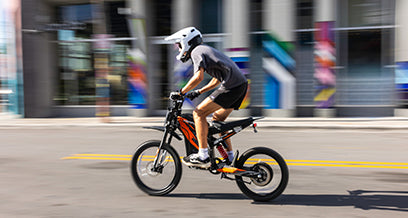
High-power electric dirt bikes and "e-motos" that exceed 750W or lack working pedals don't meet Florida's e-bike definition at all, regardless of how they're marketed. These are legally treated as motor vehicles or motorcycles, which means they generally cannot be ridden on sidewalks, bike lanes, or multi-use paths without registration.
Where Can You Ride in Florida?
Compliant e-bikes are allowed anywhere traditional bicycles are — roads, bike lanes, multi-use paths, and (in most areas) sidewalks. But this varies by class and by city:
- Class 1 and 2 are generally welcome on shared paths and multi-use trails.
- Class 3 faces more restrictions — some municipalities limit it on sidewalks and crowded trails due to its higher top speed.
- State parks generally permit e-bikes but expect riders to follow posted park rules.
Local ordinances can be stricter than state law. For example, some coastal cities restrict e-bikes on sidewalks in dense pedestrian areas, and municipalities that already cap non-e-bike motorized devices at 750W on sidewalks or paths apply that same limit to e-bikes. Always check city or county rules before riding somewhere new — Florida's statewide law is a baseline, not a ceiling.
Age and Helmet Requirements
Florida does not set a single statewide minimum age to operate an e-bike, though local governments can set their own. The one clear statewide rule: riders under 16 must wear a helmet. Helmets aren't legally required for adult riders, but wearing one is strongly recommended regardless of age.
What Happened to Florida's New E-Bike Speed Law?
If you've seen headlines about a new 10 mph speed limit near pedestrians, here's the update: that law didn't take effect.
Senate Bill 382 passed both chambers of the Florida Legislature unanimously in early 2026. It would have required e-bike riders to slow to 10 mph or less when within 50 feet of a pedestrian on sidewalks and shared paths, added audible-signal and yield requirements, and created a statewide task force to track e-bike-related crashes.
Governor Ron DeSantis vetoed the bill on June 25, 2026, citing concerns that enforcing a 10 mph threshold would require speed-detection technology and lead to increased surveillance of riders. As a result, Florida's e-bike laws remain what they were before SB 382 — the three-class system described above, with no statewide sidewalk speed cap or mandatory audible-signal rule. Some articles published earlier in 2026 still describe the vetoed provisions as current law; they aren't, as of this writing.
A related proposal that would have required a driver's license or learner's permit for Class 3 riders was also part of the broader legislative discussion but did not become law either.
Local municipalities can still pass their own path and sidewalk speed rules independently of the state — this veto only affects the statewide proposal.
Safety Standards to Look For
Look for e-bikes that meet UL 2849, the North American safety standard covering electrical systems, battery safety, and charging performance — the U.S. equivalent of Europe's EN 15194. This isn't legally required to ride in Florida, but it materially reduces the risk of battery-related fires and failures, and many insurers and dealers now treat it as a baseline expectation.
Pre-Ride Tips for Florida's Climate
- Beat the heat: Ride during cooler morning or evening hours when possible, wear breathable clothing, and carry water.
- Watch for wildlife: Trails near waterways may have alligators — keep your distance and never approach.
- Plan your route in advance: Confirm which paths, sidewalks, or trails allow your bike's class before you set out.
Frequently Asked Questions
How does Florida classify e-bikes?
Three classes based on motor behavior and speed: Class 1 (pedal-assist, 20 mph), Class 2 (throttle-capable, 20 mph), and Class 3 (pedal-assist, 28 mph). All must have a motor under 750 watts and functioning pedals.
Do I need a license or registration to ride an e-bike in Florida?
No, for any compliant Class 1–3 e-bike. Modified or overpowered e-bikes that exceed class limits can be reclassified as motor vehicles, which do require registration and licensing.
Is the new 10 mph sidewalk speed limit in effect?
No. SB 382, which would have created this rule, was vetoed by Governor DeSantis in June 2026. Florida's prior e-bike laws remain in effect.
Do I need a helmet to ride an e-bike in Florida?
Only if you're under 16. It's not legally required for adults, but it's a good idea regardless of age or class.
Can local cities restrict e-bikes beyond state law?
Yes. Municipalities can set their own rules for sidewalks, paths, and specific areas — always check local ordinances in addition to state law.


Leave a comment