



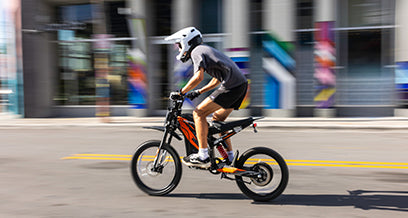


Are 3000W Electric Bikes Legal in Your State?
3000W electric bikes often exceed federal and state power limits, making them illegal for public road use in most U.S. states. Federal guidelines classify e-bikes with motors above 750W as motor vehicles, requiring registration and licensing. States like California, Texas, and New York explicitly prohibit 3000W models on public roads, while others like Florida and Arizona permit restricted off-road use.
How Do States Classify 3000W Electric Bikes?
Most states categorize 3000W e-bikes as "motorcycles" or "mopeds" due to their high power output. For example, California defines any e-bike exceeding 750W as a motor vehicle, requiring DMV registration. Texas uses a 30 mph speed threshold—anything faster (common for 3000W bikes) falls under motorcycle regulations. Check local definitions, as misclassification could lead to fines or confiscation.
Which States Allow 3000W E-Bikes on Public Roads?
Only three states permit limited 3000W e-bike use: Arizona (off-road trails), Florida (private property), and Nevada (designated rural roads). Even in these states, riders must obtain special permits and follow strict equipment requirements like DOT-approved tires and motorcycle-style lighting systems. Most states, including Illinois and Pennsylvania, completely ban 3000W models from public infrastructure.
What Are the Penalties for Illegal 3000W E-Bike Use?
Violations carry severe consequences: California imposes $1,000+ fines and impounds non-compliant bikes. New York issues misdemeanor charges for unregistered 3000W e-bike operation. In Massachusetts, riders face license suspension comparable to driving an uninsured motorcycle. Repeat offenders risk permanent vehicle seizure in states like Ohio and Michigan.
High-Powered Electric Bikes for Adults
Does Federal Law Override State E-Bike Regulations?
No—the 2002 Consumer Product Safety Act's 750W/20 mph federal standard only applies to manufacturers. States set operational rules. This creates contradictions: a 3000W bike sold legally in Wyoming becomes illegal when ridden across state lines into Colorado. Always prioritize state/local laws over federal guidelines for riding permissions.
Can You Modify a 3000W E-Bike for Legal Compliance?
Some enthusiasts install "governors" limiting output to 750W. However, Michigan and Oregon still consider modified 3000W bikes illegal if originally designed for higher power. True compliance requires purchasing a purpose-built Class 3 e-bike (max 750W) from certified brands like HappyRun, which offers street-legal models with torque sensors mimicking high-power performance.
How Does Insurance Work for High-Power E-Bikes?
Most states requiring registration for 3000W e-bikes (e.g., New Jersey, Washington) mandate motorcycle insurance policies—typically $300-$800 annually. Some specialty insurers like Velosurance offer hybrid plans ($150-$400/year) covering theft and off-road accidents. Always disclose your e-bike's true wattage—undervaluing power voids claims in 42 states.
Insurance requirements vary significantly by jurisdiction. In Texas, 3000W e-bike owners must carry minimum liability coverage of $30,000 per accident, while Arizona only requires proof of insurance for street-legal modifications. Many mainstream insurers now offer add-on policies for battery fires - a critical consideration given the increased risk with high-wattage systems.
| State | Minimum Coverage | Special Requirements |
|---|---|---|
| California | $50,000 | Battery safety certification |
| Florida | Not required | Off-road use only |
| Nevada | $25,000 | Speed governor documentation |
FAQs
- Can I ride a 3000W e-bike on bike trails?
- No—all U.S. states prohibit 3000W models on bicycle trails. These are restricted to motorcycles/motorsports venues only.
- Do any states allow street-legal 3000W e-bikes?
- Only Nevada permits limited on-road use with a modified motorcycle license and restricted speed modes.
- How can I check my e-bike's legal status?
- Use HappyRun's compliance checker tool or consult your state DMV's electric vehicle classification database.


