



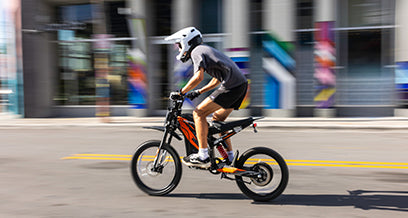


Do You Need a License for an Electric Dirt Bike?
Do you need a license for an electric dirt bike? The necessity of a license depends on the specifications of the bike and local regulations. In most cases in the U.S., the answer depends on where you ride, not just what you ride. On private property or designated off-road (OHV) trails, most electric dirt bikes require no license at all. The moment you take one onto a public road, however, the rules change fast — and for most electric dirt bikes, the answer to "do you need a license for a dirt bike" on the street is yes.
The reason comes down to a federal technicality that trips up a lot of riders. U.S. federal law (15 U.S.C. §2085) only exempts "low-speed electric bicycles" from motor-vehicle rules — bikes with fully operable pedals, a motor rated 750 watts or less, and a top motor-only speed under 20 mph. Most electric dirt bikes don't meet that description: they typically have no pedals, motors rated well above 750W, and speeds that can exceed 28 mph or more. That combination pushes them out of the "e-bike" category entirely and into the same legal bucket as a gas-powered dirt bike — usually classified as an off-highway vehicle (OHV) or a motorcycle, depending on the state.
What Are the Licensing Requirements for Electric Dirt Bikes?
-
On private land or closed OHV trails — no license is typically required, though some trail systems still ask for an OHV permit or sticker.
-
On public roads — if the bike doesn't meet the federal low-speed e-bike definition (pedals, ≤750W, <20 mph), most states require a valid motorcycle license for dirt bike use, registration/title, insurance, and DOT-compliant equipment.
-
Age and safety rules — many states also require a helmet regardless of location, and some set minimum ages or require a supervising adult for OHV trail riding.
How Do You Determine If Your Electric Dirt Bike Is Street-Legal?
To determine if your electric dirt bike is street-legal, check if it meets specific requirements set by local laws. "Can you drive a dirt bike on the road", or is it trail-only? To find out, check whether your bike meets these baseline requirements most states apply to street use:
- Having necessary safety features like lights, mirrors, and turn signals.
- Being registered with relevant authorities.
- Complying with power output limitations.
If these criteria are not met, riding on public roads may be illegal.
Which Features Make an Electric Dirt Bike Compliant with Road Regulations?
For an electric dirt bike to be compliant with road regulations, it typically needs:
- Lighting: Headlights, brake lights, and turn signals.
- Mirrors: At least one rearview mirror.
- Tires: Street-appropriate tires that meet safety standards.
Failure to have these features can result in fines or penalties when riding on public roads.
Why Do Some Electric Dirt Bikes Require Registration?
Electric dirt bikes require registration when they are classified as motorcycles due to their power output or speed capabilities. Registration ensures that the vehicle complies with safety standards and allows law enforcement to track ownership in case of theft or accidents.
Where Can You Ride Your Electric Dirt Bike Legally?
You can legally ride your electric dirt bike in areas designated for motorized vehicles if it meets all legal requirements. This often includes:
- Public roads (if registered and licensed).
- Off-road trails (typically without restrictions).
- Private property (with permission).
Always check local laws before riding.
Electric Dirt Bike vs. Gas Dirt Bike: Does Licensing Differ?
| Riding location | License needed? | Registration/insurance | Typical equipment required |
| Private property (with permission) | No | No | None, though safety gear is still recommended |
| OHV trail / off-road park | Usually no | Sometimes an OHV permit/sticker | Helmet in most states; spark-arrestor rules don't apply to electric motors, but some parks still require it |
| Public road | Yes, in most states | Yes (title, registration, motorcycle insurance) | Lights, mirrors, horn, DOT tires, VIN |
Can You Ride an Electric Dirt Bike Without a License?
Conclusion
FAQ
-
What are the licensing requirements for electric dirt bikes?
Licensing depends on the bike's power output; generally, models exceeding 250 watts require a motorcycle license. -
How do I know if my electric dirt bike is street-legal?
Check if it has necessary safety features like lights and mirrors and complies with local regulations. -
What features must my electric dirt bike have to be compliant?
It must include lighting systems (headlights, brake lights), mirrors, and appropriate tires. -
Why do some models need registration?
Models classified as motorcycles due to their power output must be registered to ensure compliance with safety standards. -
Do you need a license to drive a dirt bike on the street?
In most states, yes — because most electric dirt bikes exceed the federal 750W/20 mph low-speed e-bike threshold, they're treated as motorcycles or OHVs for road use.
-
Can you drive a dirt bike on the road without upgrades?
No. Even with a license and registration, the bike itself needs DOT-required equipment — lights, mirrors, horn, and street tires — before it can legally be ridden on public roads.


